

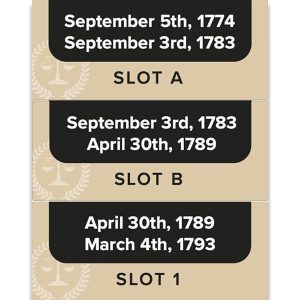
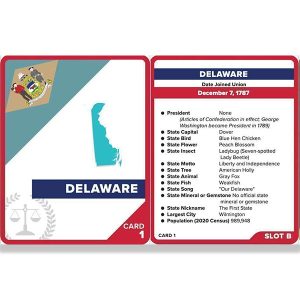
Print the deck. Each card has a picture on the front, information on the back, and a slot number in the bottom right corner. The slots run the timeline of American history, each one tied to a president or to a time period from the Preamble.
Print the slots too. Small slots set on a table or post on a wall. Big slots are larger than the cards, so you stack the matching cards on top. Teachers, tack or staple the slots to the wall left to right.
Pick three presidents. Three different men, anywhere on the timeline. Theodore Roosevelt at Slot 34, Taft at Slot 36, Wilson at Slot 37. Or jump around, Cleveland at 31, Harrison at 30, Roosevelt at 34. Pull the cards matching those three slots and set the rest aside. Vice presidents, justices, cases, amendments, innovations, states, all of it lives in those slots.
Want a deep dive? Pick one president and play his terms side by side. Lincoln 1st and 2nd. FDR 1st, 2nd, 3rd, 4th.
Shuffle and deal. On your turn, place your card on the slot you think it belongs to. Right slot, one point. Then name a fact you think is on the back. Right fact, another point.
Now your opponent. Same card, still face down. They name a fact. Then you. Then them. Point, point, point, until every fact on the back has been called and the card is learned.
Next card. Next round. Pick three more presidents and go again.
Win the round by knowing where each card belongs and what is on the back. Win the long game by learning the seven articles, the 27 amendments, 50 States, the presidents, the vice presidents, the justices, the landmark cases, and the rights they secured or took away!
Play it for fun. Play it to compete. Play it until you know your Constitution cold.Teach the history of all 50 United States in a clear, visual, and chronological way with the Constitution HQ States Cards. This printable digital deck helps students connect each state to its admission date, president at the time of admission, state symbols, population, capital, nickname, and Constitution HQ timeline slot.
How to Play
Print the deck. Each card has a picture on the front, information on the back, and a slot number in the bottom right corner. The slots run the timeline of American history, each one tied to a president or to a time period from the Preamble.
Print the slots too. Small slots set on a table or post on a wall. Big slots are larger than the cards, so you stack the matching cards on top. Teachers, tack or staple the slots to the wall left to right.
Pick three presidents. Three different men, anywhere on the timeline. Theodore Roosevelt at Slot 34, Taft at Slot 36, Wilson at Slot 37. Or jump around, Cleveland at 31, Harrison at 30, Roosevelt at 34. Pull the cards matching those three slots and set the rest aside. Vice presidents, justices, cases, amendments, innovations, states, all of it lives in those slots.
Want a deep dive? Pick one president and play his terms side by side. Lincoln 1st and 2nd. FDR 1st, 2nd, 3rd, 4th.
Shuffle and deal. On your turn, place your card on the slot you think it belongs to. Right slot, one point. Then name a fact you think is on the back. Right fact, another point.
Now your opponent. Same card, still face down. They name a fact. Then you. Then them. Point, point, point, until every fact on the back has been called and the card is learned.
Next card. Next round. Pick three more presidents and go again.
Win the round by knowing where each card belongs and what is on the back. Win the long game by learning the seven articles, the 27 amendments, 50 States, the presidents, the vice presidents, the justices, the landmark cases, and the rights they secured or took away!
Play it for fun. Play it to compete. Play it until you know your Constitution cold.Teach the history of all 50 United States in a clear, visual, and chronological way with the Constitution HQ States Cards. This printable digital deck helps students connect each state to its admission date, president at the time of admission, state symbols, population, capital, nickname, and Constitution HQ timeline slot.
Teach the history of the United States Supreme Court in a clear, visual, and chronological way with the Constitution HQ SCOTUS Cards. This printable digital deck helps students connect Supreme Court justices to the presidents who appointed them, the eras in which they served, and the major constitutional questions that shaped American law.
This educational card deck is designed for Constitution HQ gameplay, classroom instruction, homeschool study, civics lessons, American government review, legal history study, and family learning. Each card focuses on a Supreme Court justice or chief justice, helping learners understand the people who influenced constitutional interpretation across American history.
What Is Included
- Printable PDF SCOTUS card deck
- 116 Supreme Court Justice and Chief Justice cards
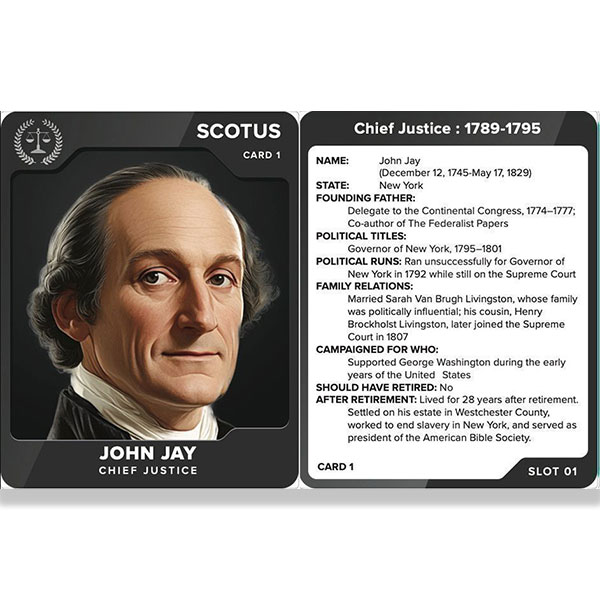
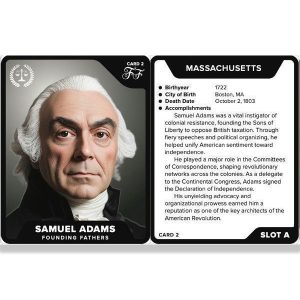
- Front cards with justice portraits, names, judicial titles, and card numbers
- Back cards with service dates, state connections, political background, and judicial facts
- Chief Justice and Associate Justice cards
- Appointing president information where applicable
- Historical notes on controversies, landmark issues, and judicial influence
- Retirement and death-on-the-bench information where applicable
- Constitution HQ slot numbers for chronological timeline learning
- Designed for classroom, homeschool, tutoring, study groups, and Constitution HQ gameplay
Educational Purpose
The Constitution HQ SCOTUS Cards help learners understand that the Supreme Court is not an abstract institution. It is made up of individual justices whose backgrounds, appointments, decisions, philosophies, and controversies helped shape the direction of American constitutional law.
Instead of studying the Court only through isolated case names, students can learn who served during each presidential era, who appointed them, how long they remained on the bench, and how their views influenced questions involving federal power, slavery, segregation, civil rights, economic regulation, criminal procedure, free speech, privacy, and constitutional interpretation.
Key Justices Covered
- John Jay
- John Rutledge
- William Cushing
- James Wilson
- John Marshall
- Roger B. Taney
- Salmon P. Chase
- John M. Harlan
- Oliver Wendell Holmes Jr.
- Louis Brandeis
- William Howard Taft
- Harlan F. Stone
- Hugo Black
- Earl Warren
- Thurgood Marshall
- Warren Burger
- William Rehnquist
- Sandra Day O’Connor
- Antonin Scalia
- Clarence Thomas
- Ruth Bader Ginsburg
- John Roberts
- Sonia Sotomayor
- Elena Kagan
- Neil Gorsuch
- Brett Kavanaugh
- Amy Coney Barrett
- Ketanji Brown Jackson
Key Topics Covered
- Supreme Court appointments
- Chief Justices and Associate Justices
- Judicial service dates
- Presidential appointment history
- Founding-era judicial figures
- Slavery and constitutional interpretation
- Segregation and civil rights
- Fourteenth Amendment interpretation
- Laissez-faire economics and government regulation
- New Deal-era judicial conflict
- Criminal procedure and Fourth Amendment issues
- Modern Supreme Court appointments
- Judicial retirement and lifetime appointment concerns
Great For
- American government teachers
- Civics teachers
- American history teachers
- Homeschool families
- Students studying the Supreme Court
- Students learning constitutional law basics
- Debate, mock trial, and law-related education programs
- Classroom timeline activities
- Constitution HQ gameplay
- Study groups and tutoring sessions
How To Use
Print the cards, cut them out, and use them as flashcards, timeline cards, classroom discussion prompts, Supreme Court review cards, quiz cards, or gameplay pieces for Constitution HQ. Learners can study the portrait side first, then review the back side to learn the justice’s role, service dates, state, appointment background, key facts, controversies, and timeline slot.
Teachers can use this deck for justice-of-the-day lessons, Supreme Court timeline walls, appointment-history activities, judicial philosophy discussions, constitutional law review, and Constitution HQ slot placement exercises. Homeschool families can use the cards as part of a structured civics, government, or legal history curriculum.
Why This Deck Works
Students often learn Supreme Court cases without understanding the people who decided them. This deck helps solve that problem by connecting the justices to their historical eras, appointing presidents, political backgrounds, constitutional issues, and long-term influence.
By combining portraits, service dates, biographical notes, judicial titles, controversies, appointing-president information, and Constitution HQ slot placement, this printable deck turns Supreme Court history into a clear, visual, and interactive learning system.
Product Format
- Format: Printable PDF
- Product Type: Digital Download
- Card Count: 116 Supreme Court Justice and Chief Justice cards
- Subject: Supreme Court, SCOTUS, American Government, Constitutional Law, Civics, U.S. History, Constitution HQ Timeline Learning
- Recommended Use: Classroom instruction, homeschool study, family learning, tutoring, study groups, and Constitution HQ gameplay
Digital Product Notice
This is a digital download product. No physical item will be shipped. After purchase, you may download, print, and assemble the cards for personal, family, classroom, or educational use according to the license terms provided with the product.
| Weight | .3 lbs |
|---|
Be the first to review “SUPREME COURT JUSTICES, PDF CARDS”
Related products
GAMES
GAMES

GAMES
FIFTH AMENDMENT AUTO-PLAQUE


Reviews
There are no reviews yet.